BUILT TIGHT.
CUSTOM-FIT.
Roofs don't leak in the middle — they leak where one material meets another. That's flashing. We install it and design it, and when stock doesn't fit, we fabricate what will.
Most roof leaks don't start in the field — they start at a chimney, a valley, a skylight, or a sidewall where two surfaces meet at a weird angle. Flashing is the detail work that holds all of those together for decades. We treat it like structural work, not an afterthought: right material, right laps, right sealants, and custom-bent in-house when the geometry demands it.
Flashing we install
Chimney Flashing
Step + counter detail, cut into the mortar — not just caulked on top.
Step Flashing
Roof-to-sidewall joint, interleaved with each shingle course.
Counter Flashing
Caps the step flashing, tucked into the wall assembly.
Apron Flashing
The lower wall-to-roof transition, sized for snow-load run-off.
Valley Flashing
Open or closed-cut valleys — metal lined under the membrane.
Drip Edge
Metal edge profile at eaves and rakes so water sheds past the fascia.
Kickout Flashing
The tiny diverter that keeps water out of the wall where a roof edge dies into siding.
Skylight Flashing
Full kit installs — head, sill, and saddle — matched to the skylight manufacturer.
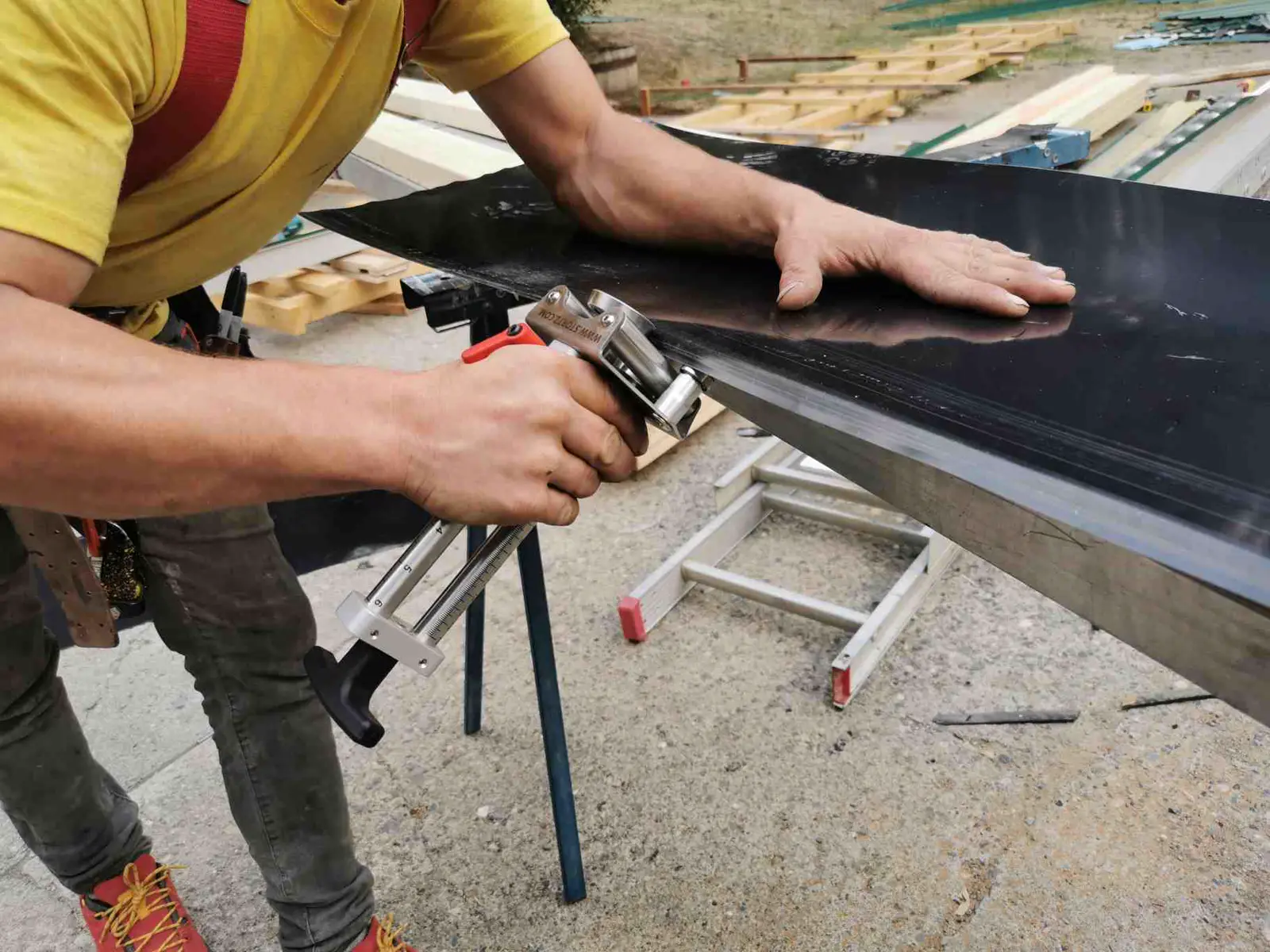
When stock doesn't fit, we bend it.
Older homes, non-standard pitches, odd parapets, historical restorations — plenty of details don't match any off-the-shelf flashing profile. We fabricate custom flashing from pre-painted steel or copper coil, colour-matched to your roof and siding, with crisp bends and clean hems.
- Pre-painted 26-gauge steel — matches standing seam, shingle, and soffit finishes.
- Copper coil on request — weathers to a living patina over years.
- On-site brake work for late-measurement fit-ups.
The detail that outlasts the roof.
Good flashing will easily outlast a shingle roof. Bad flashing — or missing flashing — is why most "roof leaks" aren't actually a shingle problem. The water found a path at a transition and ran behind the field for months before anyone saw a stain on the ceiling.
We spec flashing in three dimensions: material thickness for wind and ice, lap lengths for the pitch and regional rainfall, and sealant type where the metal meets masonry or framing. That's why a flashing detail done once should never need redoing.
Related Services
Chasing a leak?
Mystery stains, wet insulation, visible corrosion at a chimney — we'll climb up, find the source, and quote an honest repair.